Scottsdene Wastewater Treatment Works boosts water reuse to drive savings
19 May 2026
The Scottsdene Wastewater Treatment Works’ (WWTW) recently constructed treated effluent pump station is set to bolster the City’s water saving efforts by six million litres a day. This facility will provide treated effluent to more customers, which reduces the amount of drinking water used in irrigation and industry.
The City invested R32,5 million to construct a new treated effluent pump station that has recently been completed.
It supplies a number of users with treated effluent mainly for agricultural and irrigation use. With the new treated effluent pump station, the City can expand the reuse network to more customers. The pump station is able to supply six million litres of treated effluent per day to the Scottsdene treated effluent network, significantly increasing the availability of treated effluent within the area. Further development work is planned to extend the Scottsdene treated effluent network by 14km.
Industries, sports facilities, parks, developments and schools in Bellville Industria, Bellville South, Stikland, Glenhaven, Kuils River, Scottsdene, Northpine, Wallacedene, Brackenfell and Protea Heights are encouraged to engage with the City to use treated effluent as an alternative water source.
Treated effluent is extracted and screened at the inlet of the pump station reservoir and filtered downstream of the pumps. The upgraded system also includes a supply capacity for internal reuse at the WWTW as part of the treatment process. The remaining treated effluent is either reused by customers or discharged to the receiving river.
The plant has previously benefited from capacity upgrades in 2010 and 2020 to service a growing population driven by increased housing developments in the area.
What is treated effluent?
Treated effluent is wastewater that has undergone a rigorous treatment process at wastewater treatment works to remove contaminants, making it safe for discharge into the environment. A portion of this water is further filtered and supplied to customers for non-drinking uses.
It is supplied from nine City wastewater treatment plants: Athlone, Bellville, Cape Flats, Kraaifontein, Macassar, Potsdam, Scottsdene, Zandvliet and Melkbosstrand.
It is more affordable than drinking water.
It is strictly for non-potable uses such as irrigation and industrial activities.
Scottsdene ready to supply treated effluent to customers
‘Providing industry with treated effluent for non-potable purposes such as irrigation and construction is vital in our call to save water. Every litre of treated effluent used is a litre of drinking water saved, helping to preserve our scarce water resources.
‘It also makes financial sense for users, as treated effluent is a more affordable alternative to potable water. By switching to treated effluent where appropriate, businesses and facilities can reduce their water costs while contributing to a more sustainable and resilient water future for the city,’ said Mayoral Committee Member for Water and Sanitation, Councillor Zahid Badroodien.
About Scottsdene WWTW
- It was constructed in December 1976.
- The plants services Scottsdene, Northpine, Bernadino Heights, Wallacedene and Bloekombos.
- It has a designed average dry weather flow treatment capacity of 12,5 million litres per day (MLD)
After its initial construction in 1976, which saw the installation of its first wastewater treatment module, the WWTW underwent further capacity upgrades over time resulting in the current plant, which has four treatment modules. Additional upgrades up to 2008 saw the construction of mechanical screens, washer compactors and more to meet the growing demand in the area.
During 2010 the treatment capacity of the WWTW was expanded with the construction of treatment Module D and the provision of a mechanical dewatering facility to enable mechanical dewatering and offsite disposal of wastewater sludge produced at the plant.
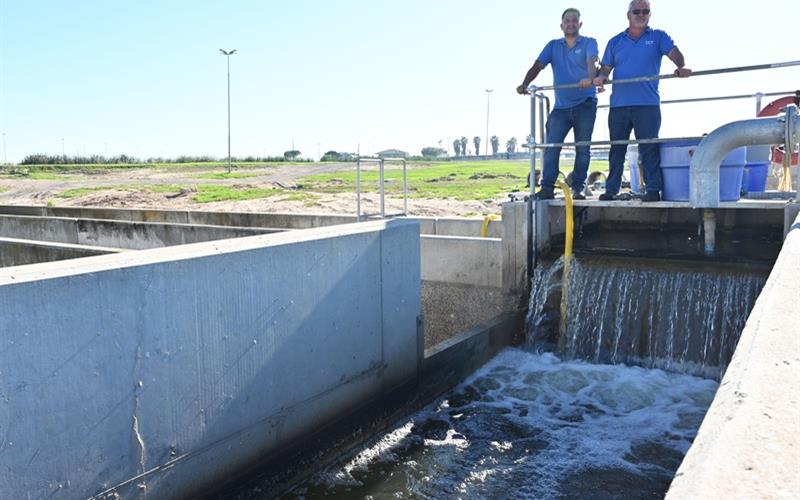
Caption 1: Clint Kleinhans (Senior Superintendent at Scottsdene WWTW) and Jacques Basson (WWTW Plant Manager) at the final discharge point where treated effluent leaves the plant for reuse.
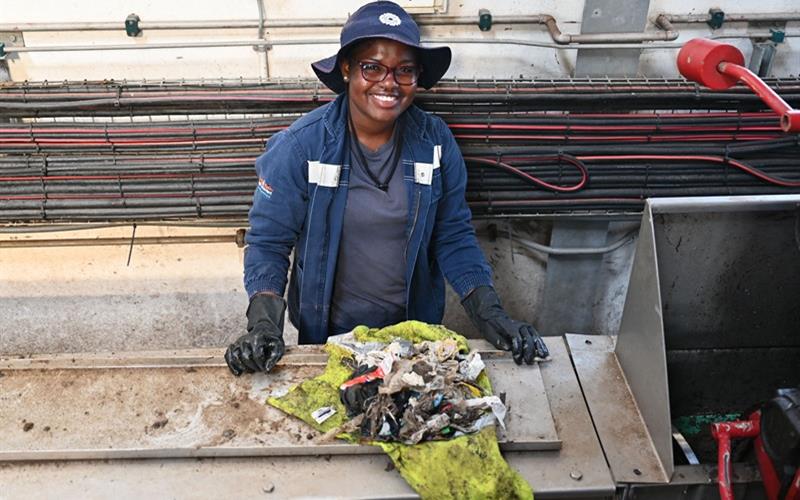
Caption 2: Process Controller Vhuhwahvho Mmbadaliga clearing foreign objects from the dewatering facility, highlighting the operational impact of improper waste disposal.
Caption 3 (Dropbox): Staff at the Scottsdene WWTW inside the newly constructed treated effluent pump station, which will expand water reuse to more customers in the area.
End
Published by:
City of Cape Town, Media Office